These texts explore three interconnected dimensions of my practice: the conditions from which my work emerges, the formation of a personal visual vocabulary, and the questions that have come to inhabit it.
A Vocabulary in Formation traces how forms emerge, persist, and transform across mediums. The Discomfort of Being reflects on why the questions explored through these forms have become increasingly urgent.
As a visual artist, I explore the instability of perception and the fragile boundary between imagination and reality.
My work is rooted in an intuitive and reflexive approach, where form does not pre-exist but emerges through processes that remain partially indeterminate. Drawing, digital environments, sculpture, and installation are not separate practices, but different conditions through which the same visual language unfolds.
Across these works, I am less interested in representing the world than in constructing perceptual situations — spaces where the image hesitates, fluctuates, and resists full resolution. The indiscernibility that runs through my practice is not an effect, but a necessary condition: it activates the gaze, inviting the viewer to project, interpret, and complete what is never fully given.
This process is guided by what I describe as viscerality — a state where attraction and discomfort coexist. Forms may appear unstable, fragmented, or even unsettling, yet they retain a certain intensity that operates beyond representation. Meaning does not precede the image; it emerges through the experience of perceiving it.
Working across mediums is essential to my practice. Form moves from drawing to sculpture, from digital simulation to physical matter, and back again, revealing its capacity to persist, transform, and reappear across different states. The medium is never an end, but a condition that shapes how form can emerge.
Ultimately, my practice seeks to create experiences that foster introspection and perceptual awareness — spaces where the viewer encounters not a fixed image, but the very process through which images come into being.
My work is structured by recurring forms that emerge, transform, and reappear across mediums. These forms do not begin as deliberate symbols; instead, they arise unexpectedly from the process — a shape might recall an egg, a shell, or a feather. I do not set out to represent them; they reveal themselves.
Once present, these forms recur — not as fixed meanings, but as carriers of tension: protection and exposure, emergence and collapse. Their meaning is never static; it arises through perception and transformation.
As these forms pass from drawing to sculpture, from digital to physical, they retain traces of their past states while continually evolving. What endures is not a fixed definition, but an ever-changing field of associations — inviting the viewer into a space of open perception, where meaning is always unfolding.
My work has been moving through different themes. Each time I begin a new phase, the distance from which I approach them shifts.
Looking inward and addressing my own practice every now and then is necessary to me.
In the works I now understand as Foundations of Introspection, interiority was a space from which I questioned existence, within an interest in perception, consciousness, memory, and the unstable territory between an inner reality and the world outside it. I wanted to understand what constitutes the experience of being a self.
And this revealed fractures.
With Dissecting Egos (The Anatomy of the Broken Ego series), the body became a territory through which these fractures could acquire form. Anatomies distorted, opened, multiplied and reorganized themselves. The more closely I examined the self, however, the less convinced I became that it could be understood in isolation.
The question keeps shifting.
What has participated in making me who I am?
This led toward The Things We Carry On. I became increasingly interested in what precedes individual consciousness: memory, inheritance, family structures, cultural codes, histories, fears and attachments. We enter existence already carrying things. Some are transmitted deliberately; others reach us without language.
What we call the self may therefore contain much that was never consciously chosen.
And if this is true, where does the self begin?
Where does it end?
Eventually, my gaze moved further outward, toward the systems within which lives are situated. Cartographies of Control emerged from this displacement.
Control does not always announce itself as force. It can operate through boundaries, classifications, architectures, permissions, expectations—through possibilities made available or withheld. I became interested not only in the systems surrounding us, but in what happens when external structures become internal conditions.
Systemic Dissonance became an important threshold in this process.

The barbed wire entered the work consciously, alongside recurring forms such as the brain, the uterus and the teddy bear. I was thinking about conditioning and silencing, and particularly about the ways women’s bodies, voices, desires and reproductive capacities continue to be prescribed and contested.
But gradually, the boundary itself became more complicated.
A fence usually separates one territory from another. Closed into a circle, it establishes an inside and an outside, yet has no obvious beginning or end. And when that boundary begins to inhabit the body itself, another question emerges:
What happens when the structures that constrain us are no longer entirely outside us?
Conditioning begins long before we have the language to recognize it.
We inherit ideas about success, beauty, strength, normality and belonging. We learn what should be desired and what should be feared, what constitutes achievement and what signifies failure. By the time we begin questioning these structures, they have already participated in shaping the consciousness through which we question them.
This is where my current work begins.
With discomfort…
I find myself increasingly uneasy with the ways contemporary life assigns value to human existence. We are encouraged to perform, achieve, improve, remain resilient, become visible, become stronger, become more.
Bodies are measured. Work is measured. Intelligence is measured. Beauty is measured. Even our capacity to withstand exhaustion can become another measure of performance.
At the same time, we live amid war, displacement, violence, instability and collective exhaustion. Images of catastrophe coexist strangely with the language of optimization and personal achievement.
Something does not align.
I often find myself wondering what it means to perform successfully inside a world whose definitions of success increasingly trouble me.
And beneath that question lies a simpler one:
Why can we not simply be?
The sculptures gathered under The Discomfort of Being emerge from somewhere inside this uncertainty.
I do not make them as illustrations of these ideas. Much of their morphology arrives intuitively. Forms grow, mutate, connect and fold into one another. Sometimes I understand a relationship only after I have made it.
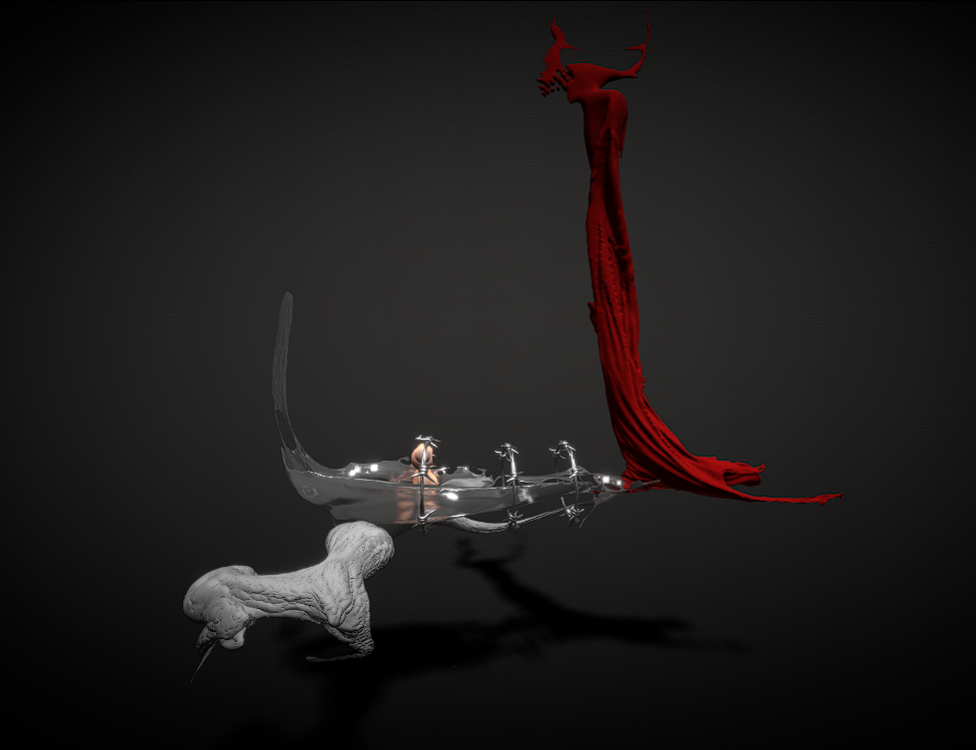
Yet certain forms return: a brain, a shell, a boat, a teddy bear, a muscular body, barbed wire. Their recurrence does not establish a fixed symbolic language. Each time they appear, their relationships and conditions have shifted.
Even the barbed wire changes. At times it becomes glass: transparent, fragile, almost immaterial, while still capable of defining a boundary.
A contradiction that troubles me.
A boundary does not cease to operate simply because it becomes difficult to see.
Perhaps conditioning works in a similar way. What begins as an external prohibition can eventually become expectation, habit, self-protection, ambition or even desire. At some point, distinguishing between what has been imposed and what we experience as our own becomes increasingly difficult.
The recurring muscular body has made another question emerge around strength.
It carries. It sits. It lifts. It climbs.
Why is strength required in the first place?
When did endurance become a virtue? When did the ability to withstand pressure become evidence of worth? And what happens when strength is less an expression of freedom than a response to the conditions one has been given?
In The Pursuit, a figure climbs a broken ladder.
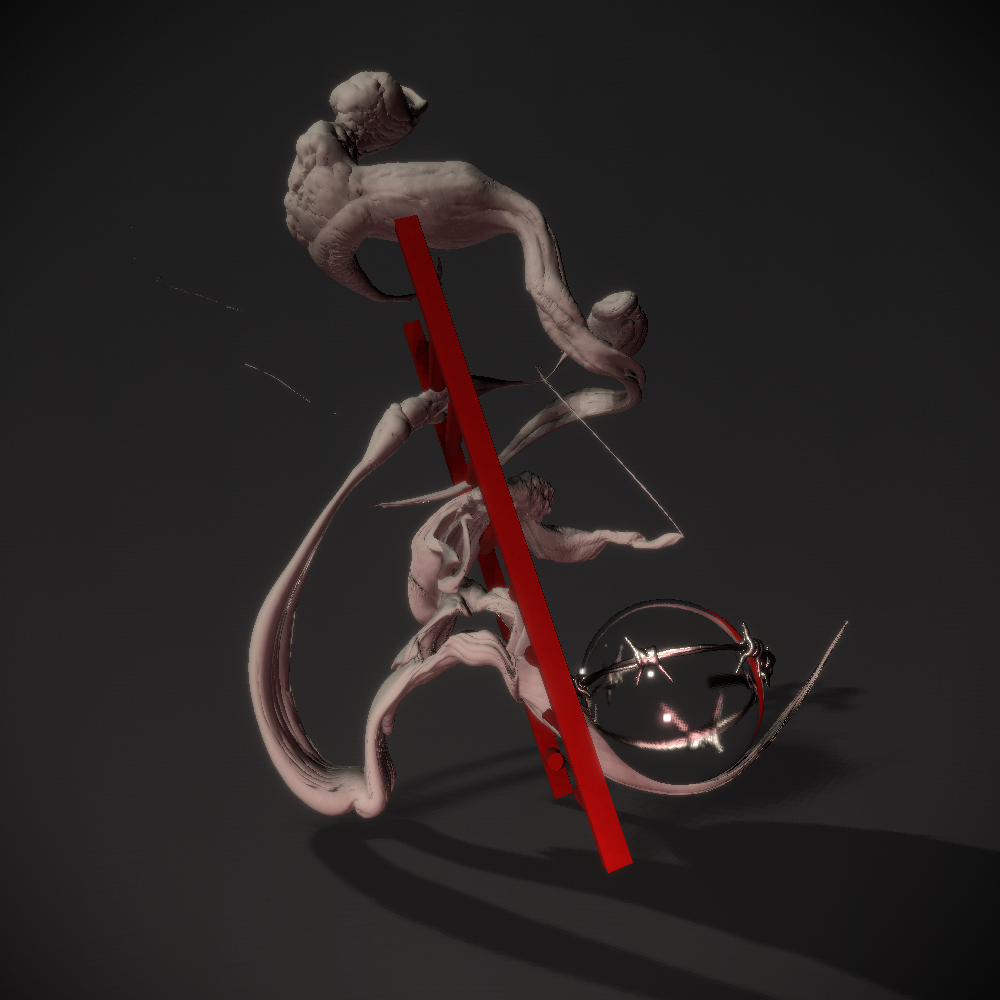
The ladder interests me because it contains an implicit promise: that there is somewhere higher to go. Its structure turns movement into progression. Each rung suggests another rung; effort appears to produce advancement.
But the ladder is already broken.
And still, the climbing continues.
We learn early to associate movement with progress, effort with merit and arrival with success. Yet the pursuit can continue long after its purpose has become unclear.
How much of what we pursue originates in desire, rather than in what we have learned to desire?
A question which brings me increasingly toward the notion of agency.
We act from within bodies, histories, languages, memories, expectations and systems we did not create. We do not choose the world into which we arrive.
But neither are we entirely passive within it.
We adapt. Resist. Repeat. Refuse. Carry. Reconfigure.
Sometimes we reproduce precisely what we are attempting to escape. Sometimes what appears to be submission may be survival. Sometimes strength is chosen; sometimes it is required.
Agency, then, may exist somewhere within this negotiation—not outside conditioning, but in an unstable relationship with it.
This is perhaps why the idea of rehearsal continues to resonate with me.
A rehearsal implies intention. We repeat something because we imagine it can be prepared, altered, perhaps improved.
But a rehearsal also presupposes a script.
How much of a life is improvised, and how much has already been rehearsed for us?
We inhabit identities we did not invent entirely. We pursue definitions of success that existed before us. We learn roles before we understand that they are roles.
And still, something can deviate.
Something can refuse.
Something can become otherwise.
I do not want these sculptures to resolve that contradiction.
Strength may be built upon fragile foundations.
Looking back across the different periods of my work, I no longer see a linear progression from one concern to another.
Interiority led me toward the ego. The ego led me toward what we carry. What we carry led me toward the structures surrounding us. And those structures eventually led me back inside, toward the ways the outside becomes embodied, internalized and difficult to distinguish from the self.
I began inside.
I moved outward.
And somewhere along the way, I discovered that the outside had already entered.
Perhaps the question has remained the same all along:
How much of ourselves can remain undetermined within everything that has already participated in making us who we are?